Description
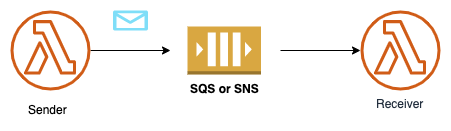
When Lambda function code sends a message to a SQS or SNS channel directly, the application's topology is hidden inside the function code. To figure out how messages move, you have to look at the code.
An example might look as follows:
queue_name = os.environ['SQS_NAME']
sqs = boto3.resource('sqs')
queue = sqs.get_queue_by_name(QueueName=queue_name)

def handler(event, context):
   ...
  response = queue.send_message(MessageBody='world')
Solution
Use Lambda Destination to send the message and configure the channel name in CDK or CloudFormation to make the application topology explicit.
See the CDK implementation in Typescript on GitHub.
Considerations
Advantages
- Extracting the message sending into a destination makes the application topology explicit and separates composition from application logic
Applicability
Lambda Destinations are triggered only for asynchronous invocations. Therefore, this refactoring cannot be applied to synchronous invocations, e.g. from the console. If your functions returns a synchronous result, this is now replaced by the message to be sent
Lambda Destinations are triggered at the end of the function execution whereas the code could send the message at any place. However, as the consumptionm of the SQS or SNS channel takes place asynchronously, this won't affect the overall flow.
Sending a message from code allows you to set additional attributes like
MessageDeduplicationIdorDelaySeconds. You cannot set these attributes from a Lambda destination.Destinations that invoke another Lambda function have the option to send the message body only, i.e. the data structure that your function returns (via the
responseOnlyoption inLambdaDestinationOptions). No such option exists for destinations that send messages to SQS or SNS. The message therefore includes the event wrapper and the actual data structure inside thedetail/responsePayloadelement. This change will affect downstream event consumers. To maintain the same message format without the wrapper, you would need to direct the destination to an EventBridge, which filters the message content and then passes it onto the SQS chanel or SNS topic. An example of this is shown in the Loan Broker CDK Example
Related Refactorings
Created by:


