
Functions enable encapsulation and code re-use. Most programming languages support the concept of code synchronously calling functions within a code base. In this case, the caller waits until the function returns a response.
When this happens on a traditional server or virtual instance, the operating system scheduler switches to other available work. Whether the CPU runs at 0% or 100% does not affect the overall cost of the application, since you are paying for the fixed cost of owning and operating a server.
This model often does not adapt well to serverless development. For example, consider a simple ecommerce application consisting of three Lambda functions that process an order:
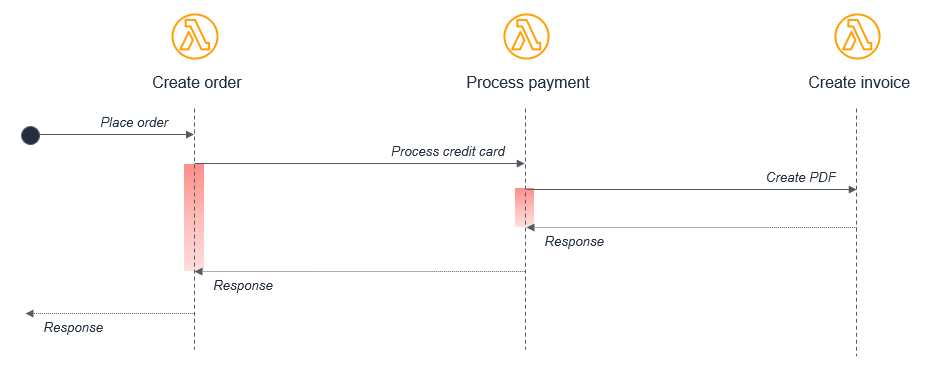
In this case, the Create order function calls the Process payment function, which in turn calls the Create invoice function. While this synchronous flow may work within a single application on a server, it introduces several avoidable problems in a distributed serverless architecture:
- Cost: with Lambda, you pay for the duration of an invocation. In this example, while the Create invoice functions runs, two other functions are also running in a wait state, shown in red on the diagram.
- Error handling: in nested invocations, error handling can become much more complex. Either errors are thrown to parent functions to handle at the top-level function, or functions require custom handling. For example, an error in Create invoice might require the Process payment function to reverse the charge, or it may instead retry the Create invoice process.
- Tight coupling: processing a payment typically takes longer than creating an invoice. In this model, the availability of the entire workflow is limited by the slowest function.
- Scaling: the concurrency of all three functions must be equal. In a busy system, this uses more concurrency than would otherwise be needed.
In serverless applications, there are two common approaches to avoid this pattern. First, use an SQS queue between Lambda functions. If a downstream process is slower than an upstream process, the queue durably persists messages and decouples the two functions. In this example, the Create order function publishes a message to an SQS queue, and the Process payment function consumes messages from the queue.
The second approach is to use AWS Step Functions. For complex processes with multiple types of failure and retry logic, Step Functions can help reduce the amount of custom code needed to orchestrate the workflow. As a result, Step Functions orchestrates the work and robustly handles errors and retries, and the Lambda functions contain only business logic.