
Let’s look at the four API lifecycle phases and 10 activities:
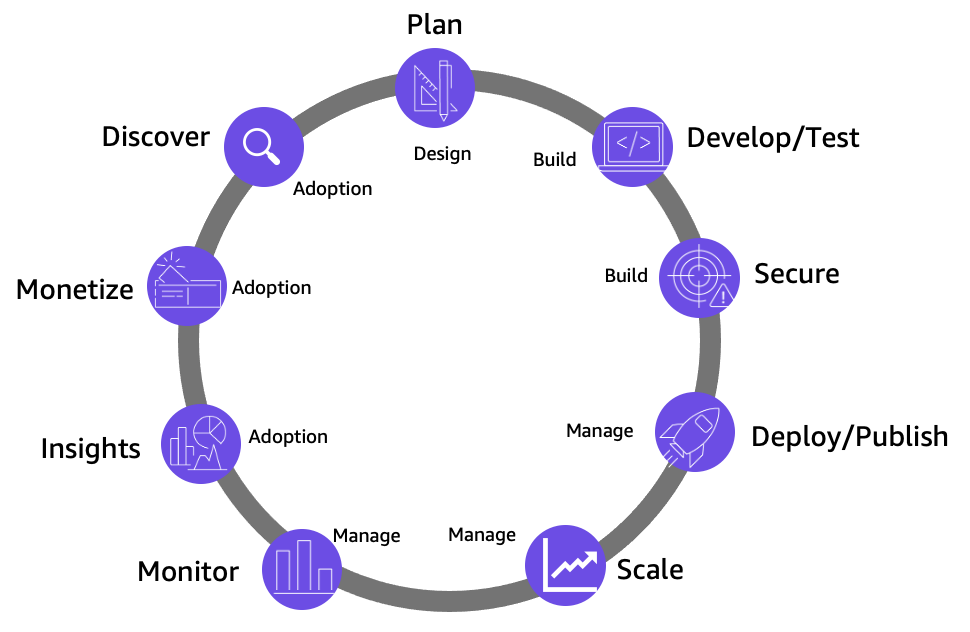
The design phase involves working backwards from business capabilities to identify the API contract. The steps will vary depending on the type of the API. For REST APIs, design identifies resources and methods. For GraphQL API, it defines the data model. Resulting design will serve as a basis for developing, testing and documenting the APIs.
API management focuses on deployment and maintenance of APIs once deployed. It involves securing APIs, maintaining deployment pipelines, scaling and monitoring.
Once APIs are in use, the usage data provides insights for optimizations. Monetization focuses on activities related to the revenue generation.
Finally, as you scale the number of API products, consumers need an easy way to discover APIs and build integrations. Developer support is critical here to reduce adoption barriers.
Here is another view of the API lifecycle which maps activities to the personas and teams performing them:

Created by: